This is the third part of my Tales From Japan series, a collection of posts that delve into a 2023 trip to The Land of The Rising Sun. Don’t forget to check out parts 1 and 2 first to learn about our escapades throughout central Honshu.

Seeking Deer
Nara was probably the first item on our Japan “to do” list before anything else. Ahead of the likes of even Tokyo and Kyoto. This was due to the city’s famous grass-eating mascots, The Nara Deer – Herds of extremely tame, but still wild, Sika deer that feed out of your palm and even bow to you if you greet them in the same manner.
Located just a 45-minute train ride away from Kyoto, the city shares lots of similarities to its famous neighbour with its vast complex of shrines, parks, and the Toda-ji temple that until recently held the record for the world’s largest wooden structure.
Using our final rest day in Kyoto, we arrived in the sweltering early morning heat and began our ascent from the station up toward the main park. The town itself was beautiful – Deciding to take the scenic route through the back alleys we admired the edo-esc architecture and, to our surprise, the distinct lack of people.


Getting closer we immediately caught sight of the four-legged celebrities freely wandering the roads, lying down at bus stops, and harassing anyone who had an ounce of food on them. Seen as a sacred symbol in Japan, the deer are treated with the utmost respect allowing them to become as tame and dosile as they are. This is only helped by the tourists (like us) who buy small crackers from stalls dotted around the park to feed them with, a great experience but one that wasn’t all sunshine and rainbows…
From the second you purchase the crackers, deer from every corner of the park begin their march toward you, becoming an unstoppable force. You end up doing a form of dance – step back, deer forwards, reach out, hand over a cracker, repeat. They have been known to knock people over in their relentless conquests for food. However, in our experience, the deer were very good at leaving you alone if you showed them your empty hands.
The original plan in Nara was to see the deer, spend an hour or so exploring, and then head off back to Kyoto. But once Yas caught wind he promptly presented us with a leaflet displaying the buckets of temples and optimum walking routes around the city to maximize our time. Not wanting to miss out, we decided we’d tick off a few of them starting with Toda-ji as it was only a short walk away. However, when we began to get closer to the grounds we noticed something unusual about it. The gates to get into the complex were the size of a small tower block, far bigger than any we had seen before. Weaving our way through the heard of deer, and smattering of people, we reached the inner wall that the temple itself was hiding behind – A literal and metaphorical paywall. We paid the small entry fee, turned the corner, and audibly gasped.
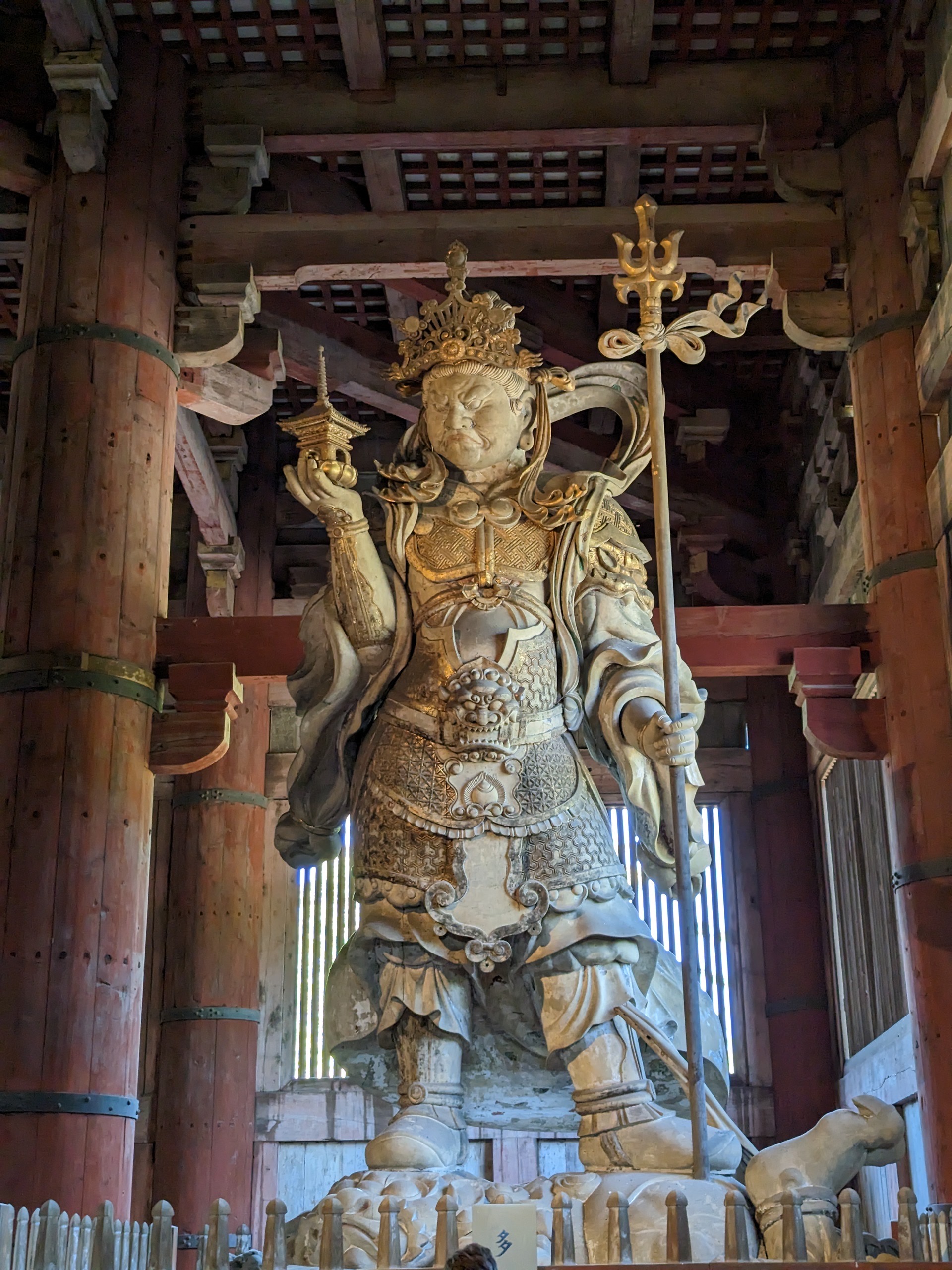
Originally dating back to 752, and housing a 15m bronze Buddha statue, the temple stands at a whopping 50m making it one of the world’s largest wooden structures. Its scale was truly jaw-dropping and one that unfortunately photos do not give full justice to. What is even more astonishing though is that the current 1692 incarnation of the temple is in fact 30% smaller than the original. Absolutely breathtaking. It took around 30 minutes to actually go inside because I couldn’t stop looking up and staring at the facade. When we eventually did go in, we were greeted by the Buddha who sits pridefully in the center of the vaulted room surrounded by his ever-vigilant Bosatsu.



Maybe it was due to the weather but I thought Nara was above and beyond anything Kyoto had thrown at us. A great day in a stunning setting that was capped off with meeting our new tour members when we arrived back in the early evening. The only minor damper was the beef I ordered that night for dinner was certainly no A5. Tough as leather, some say I am still chewing to this day.



Hiroshima Peace Memorial Park
The next morning it was time to get back on the shinkansens. This time our destination was Hiroshima, a city with a tragic past but one that has rebuilt itself into a beautiful, modern, metropolis surrounded by rolling hills and coastal islands. It was somewhere we wanted to visit but we were both slightly concerned about how it would feel walking around a city that had been the victim of such haunting events 78 years ago.

Much like Kyoto there is no metro link in Hiroshima with trams being the preferred method of public transport. After a short journey, we quickly checked into the hostel and headed out to the Peace Park and Museum. Walking through the streets you’d be forgiven for not knowing what happened here, it looked just like any other thriving Japanese city we had been to. It was only when we walked past the impact point that things started to become a bit more obvious. It’s a simple slab with a plaque, but imagining the destruction and hell that was triggered above was hard to fathom. About 100m away was the famous Genbaku Dome, a prefectural office building that became the only structure to survive nearby. Everything else was leveled. Surrounded by beautiful parks and flower beds, it stuck out like a sore thumb as a stark reminder of both the city’s past and its defiance to be broken. Yas talked us through it and told us that until recently you could see the silhouette of a man vapourised into the side of the wall. The sun had caused it to fade as the years went by.

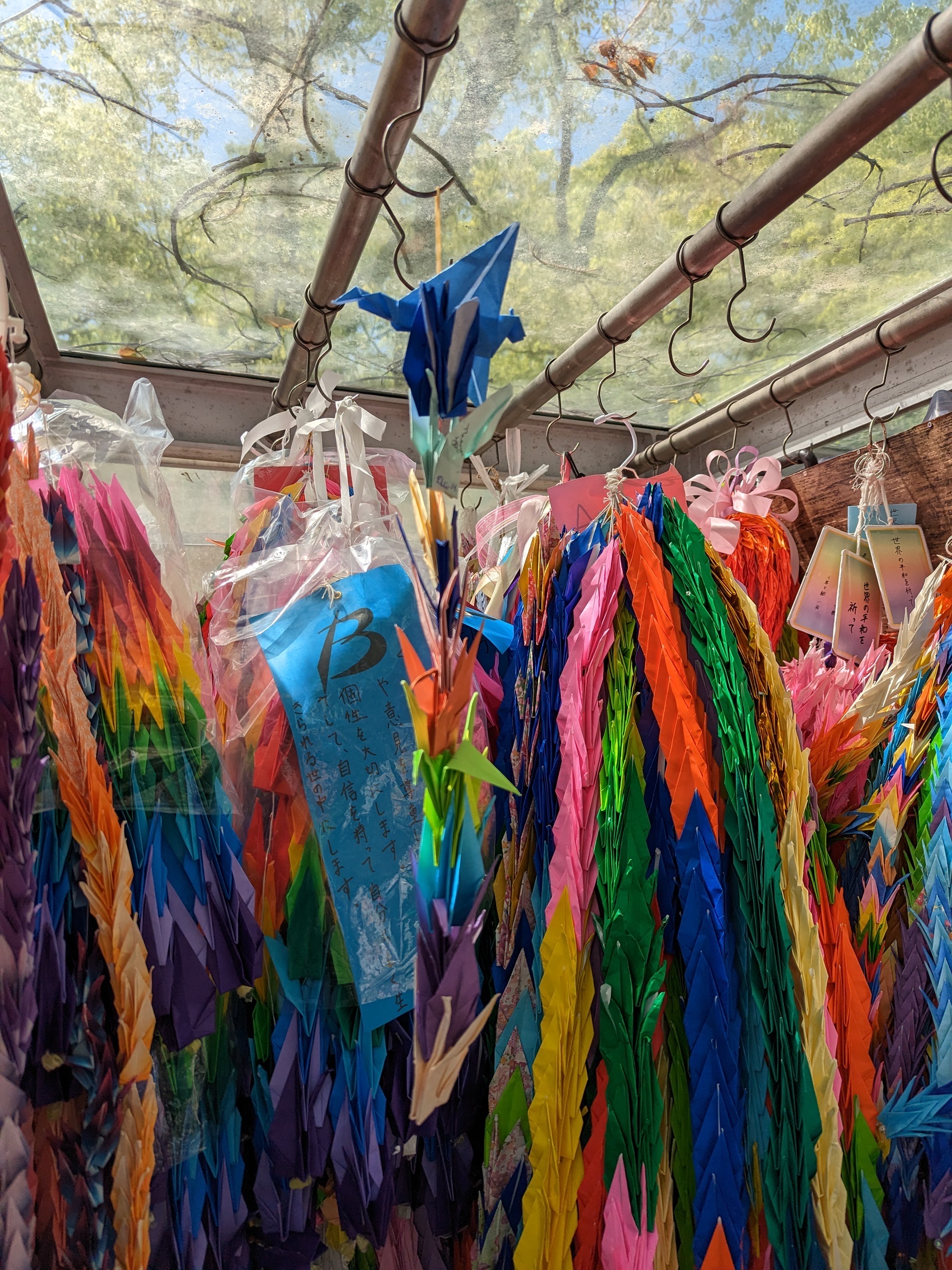
We then walked over to the children’s peace monument which lay across the river. This memorial was erected to remember the children who lost their lives that day and in the years to come from radiation poisoning. The symbol above is of an origami crane to honor Sadako Sasaki a young girl who initially survived the blast effects but died 10 years later from blood cancer aged just 12 years old. Whilst in hospital she began folding origami cranes which were believed to provide good luck. Over her stay, she folded over 1000 but unfortunately, it was not enough. After her passing her school friends fought day and night and eventually got the monument built in her name. It has since become tradition for visitors to donate other origami cranes next to the moment as a sign of respect. Yas passed us one each and then got a large chain of them out of his bag. This was a gift from Sophie, a friend I knew from Yas’ previous tour group, who asked him to donate them when he was next here. We put the cranes in the boxes surrounding the monument, adding them to the collection which must have contained thousands already.
From here we headed to the memorial park, stopping at the Flame of Peace and the Cenotaph. Alongside the Cenotaph are the names of the victims etched in stone with new names added each year as the death toll grows ever onwards. Yas even pointed out that some of his distant relatives are named on the memorial, a fact that hammered home the wide-reaching effects of the bomb.

Finally, it was time for the museum, a place I will never forget. Walking around it was un-nervingly silent. Despite there being a large number of people inside you could hear a pin drop. Everyone was busy processing the horrific images they were seeing. There were first-hand accounts, damaged clothes and possessions, and even images of the aftermath by a resident whose first thought post-blast was to record it for the world to see. The most harrowing for me however was the paintings that one of the survivors did years later. They depicted ghost-like figures walking aimlessly with flesh falling off of their skin, skies aflame, radioactive black rain, and pure chaos. The survivors were arguably the unlucky ones with 3rd-degree burns, blindness, burst eardrums, and high cancer chances among the things that affected them.
It was all incredibly impactful and I am glad we visited. It is obvious that nuclear bombs are awful but it’s only when you read the destruction they cause from the accounts of those who experienced them first-hand that you see the true terror and all its malice. Walking out the mood was very solemn. Yas decided we needed something lighter to pick everyone’s spirits up so we began walking to Hiroshima castle.

The Pancake Effect
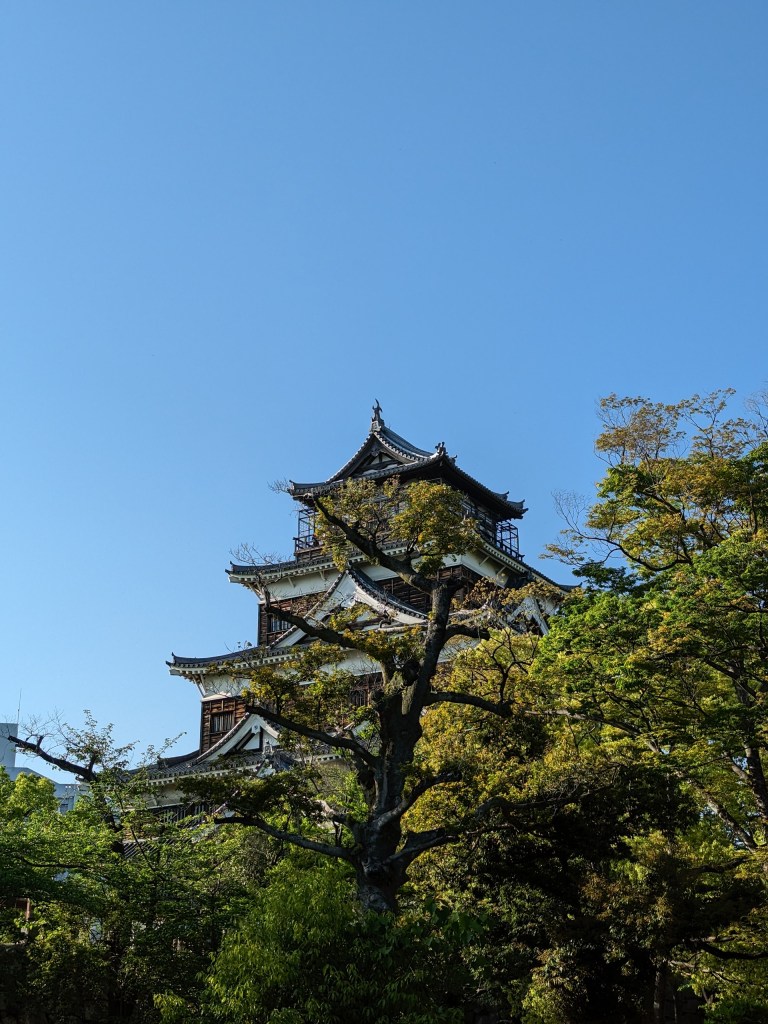
The castle itself has been rebuilt a couple of times since the war with one of the incarnations even including a roller coaster that went straight through it (although photos for this seem to be elusive).
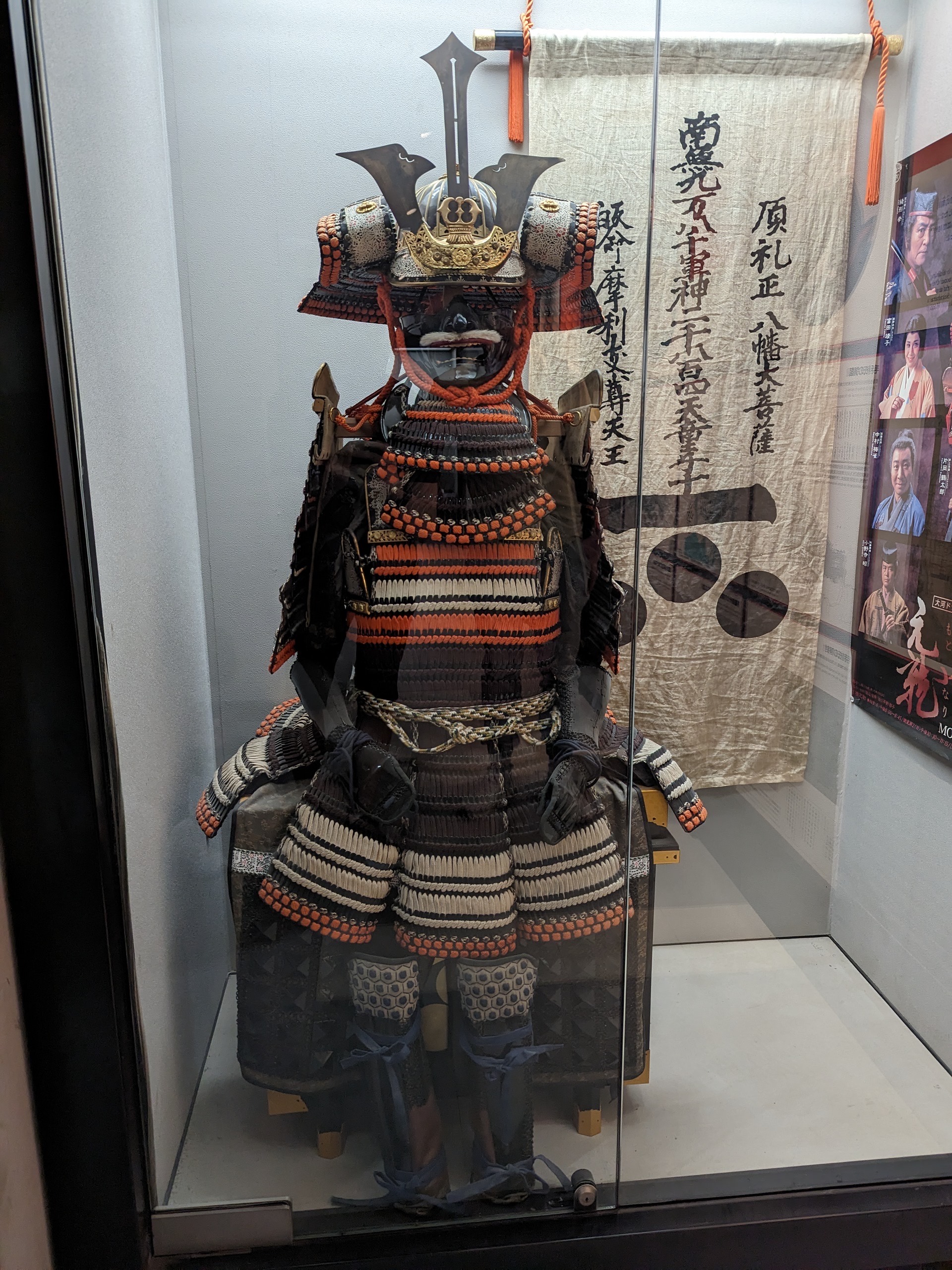
Unfortunately (or fortunately), the version that stands today does not have any rides midway but instead houses a collection of samurai artefacts. Katanas, longswords, armor, and art, as someone who loves that period it was fascinating to see the weaponry up close. In classic Japan style it had its own mascot too, a cat with a castle for a hat.
Once at the very top of the main keep, we were provided with great views as the sun dipped beneath the mountains. Looking around you could see all across Hiroshima Bay and out towards Miyajima Island, the location of tomorrow’s day trip.


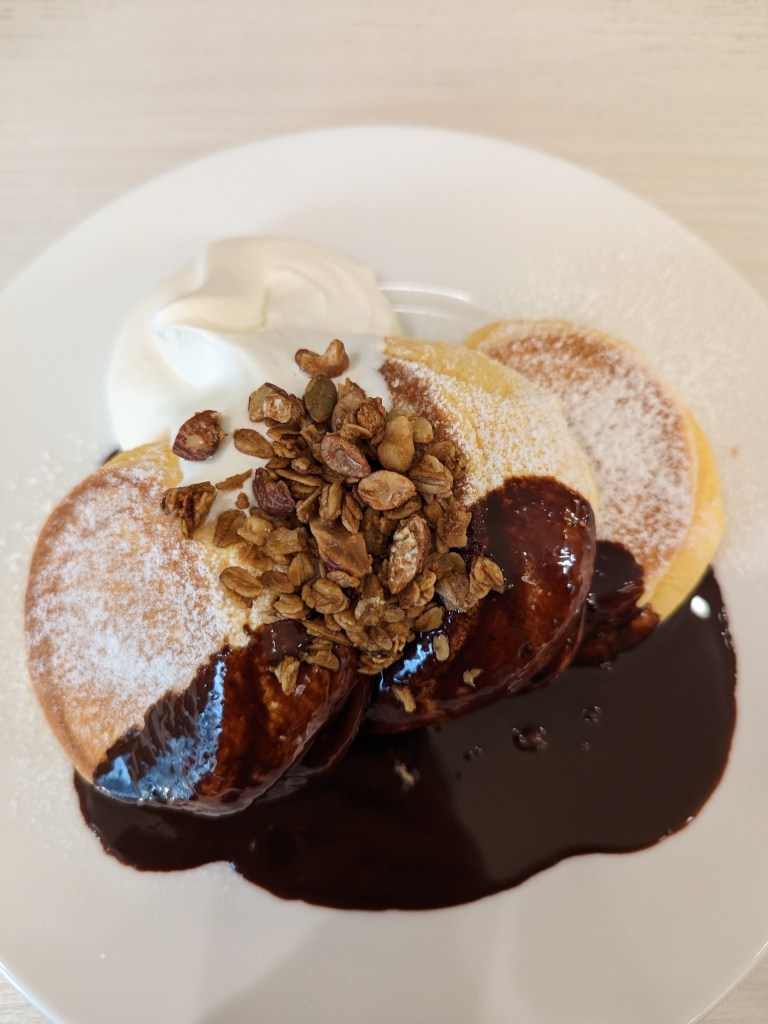
Shortly after we headed to what has since been dubbed by me, the greatest restaurant in the world – Happy Pancake. A sensational establishment that served Japanese-style pancakes. These pancakes are more like soufflés – fluffy morsels of perfection. Four pancakes soft and light as a cloud with a rich chocolate sauce meandering its way down them towards the velvet smooth ice cream beneath. Much like with the A5 a few days prior, I did leave the restaurant quite angry due to the fact that it has ruined all other pancakes for me forever.
The rest of the day was spent wandering through the streets of Hiroshima, exploring all the city had to offer. When the evening eventually rolled around, it was time for yet more “pancakes” in the form of Okonomiyaki. However, the people of Hiroshima were very loose with their definition of ‘pancake’ this time around.

We sat down around a big flat-top grill, placed our orders, and watched the chef do his magic. The entire meal was a show. In essence, the pancakes were crepes covered in cabbage, beansprouts, bacon, noodles, a fried egg, and sauce. You could then choose an extra topping, bacon for me, Kimchee for Lucy. I would not be exaggerating to say it looked like a dog’s dinner, but it tasted amazing. They even gave you a small spade to eat it. With the drinks flowing, jokes from the chefs, and the baseball on in the background (in which Yas was deeply embedded), it was a great experience.

The Lost World
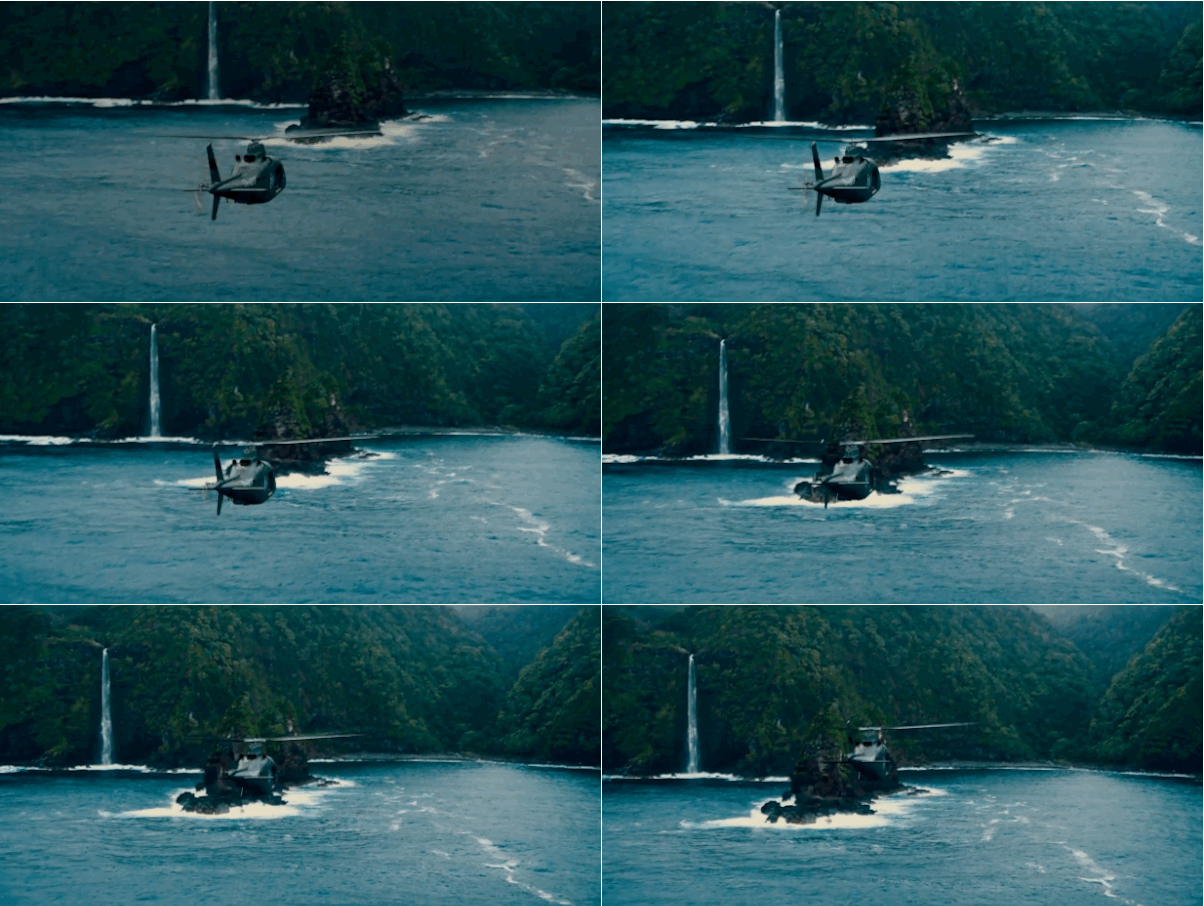
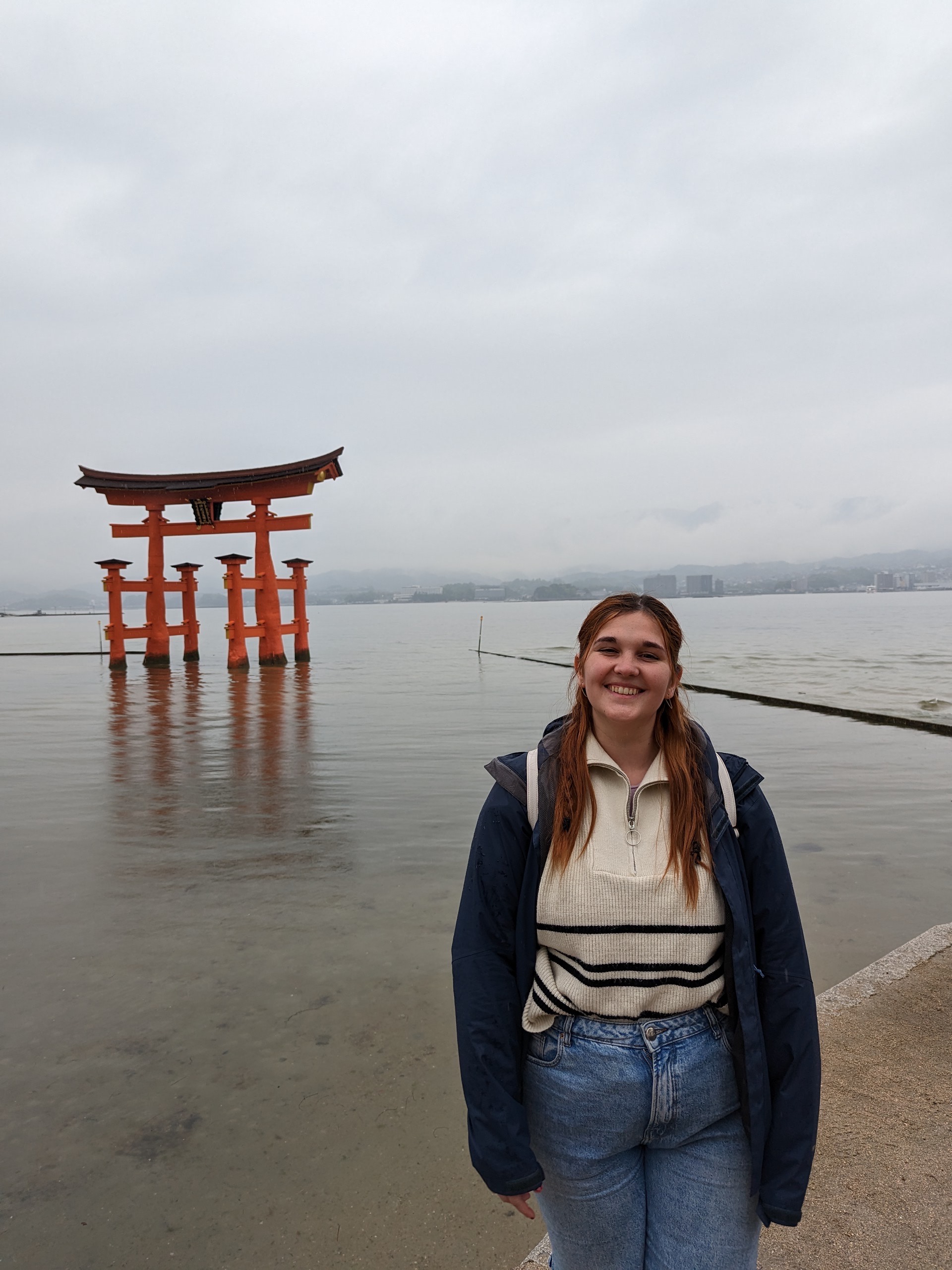
Miyajima Island is a smallish island just off the coast of the city that is home to the famous “Floating Tori Gate”, our next point of call. Waking up at the crack of dawn we got a quick train to the port where we boarded the ferry which would ship us the small distance across the bay. The weather wasn’t great at all, overcast, wet, and very dreary. However, this set an extremely atmospheric scene across the island. Low clouds clung to the jungle hillsides creating a landscape scene straight out of the opening moments of a Jurassic Park film.
As we got closer, we began to see the Tori gate that the island has become renowned for. Located about 100m from the coast it is not built directly into the ground so is said to be floating – alas weighing in at 60 tons, it most definitely does not float. It was very striking to see the massive gate in all its bright red elegance juxtaposed with the gloom of the day.
When the ferry eventually docked we hopped off and began walking through the port town enroute to the gate. The town was filled with a plethora of tourist shops but also had some really good food including the speciality of the region, oysters. Normally I’m extremely opposed to anything “slimy” with oysters being high on the “do not eat” list. Yet, fueled by the fact that we were on the other side of the world, I was trying more and more to throw myself into new things. So without much hesitation, we ordered some grilled (luckily) oysters and I have to say, they weren’t that bad. The stall next door was offering maple leaf-shaped apple pies which provided a great way to wash them down.
Strolling down the streets we could see the pagoda in the distance in a scene that looked more like something out of a video game than real life. It was at this point that it slowly became busier and busier so we realised we must be approaching the gate. Towering just offshore it looked like the entrance to a long-lost sunken kingdom. At low tide, you can even walk directly under it, but unfortunately when we visited the tide was high and none of us had packed a swim suit.


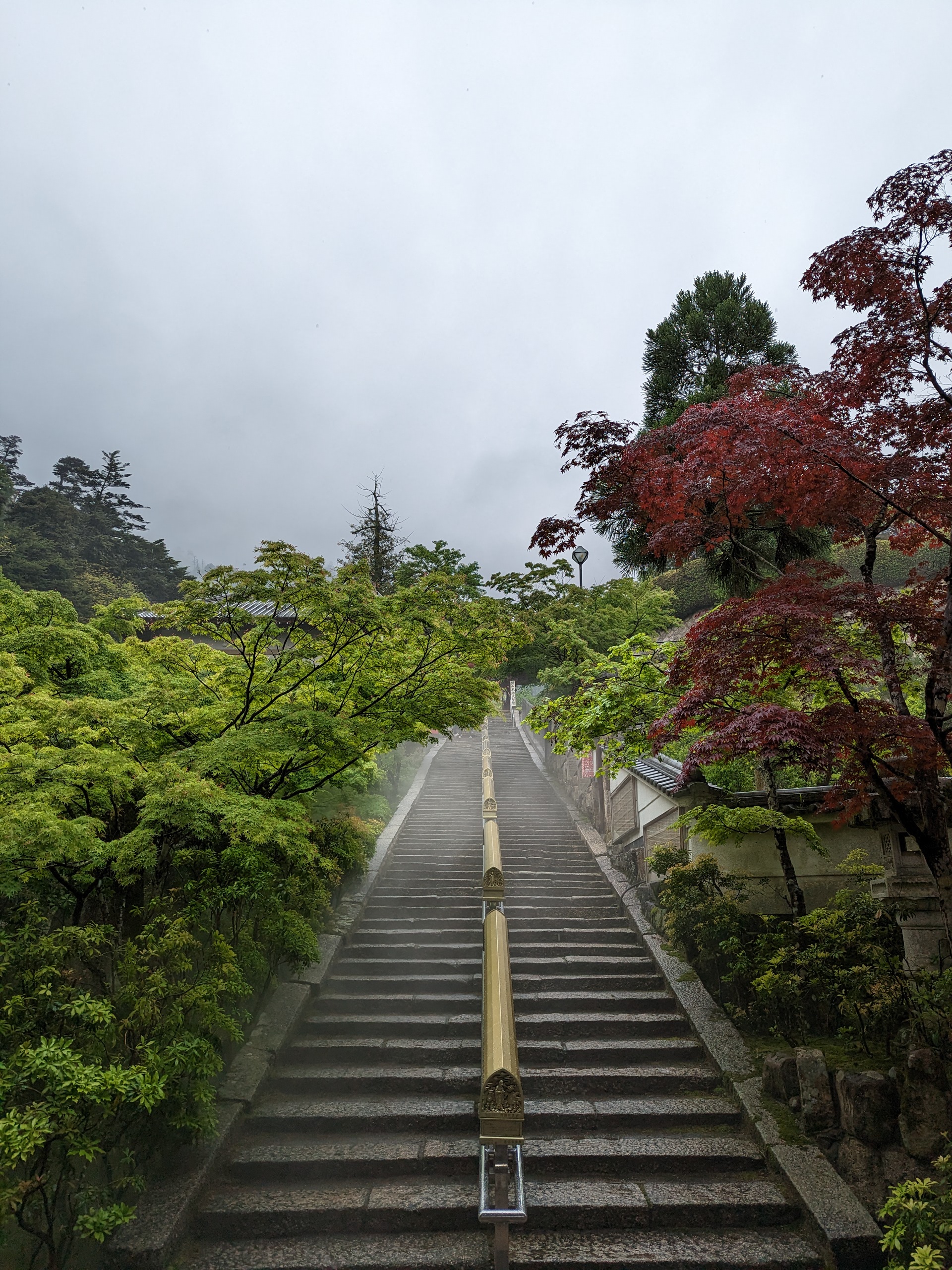
After 10 or so minutes at the gate, Yas presented us with a proposition, walk with him to a temple in the mountains or head home. Around 6 of us decided to stay while the others returned to Hiroshima. Nestled a few hundred meters up the hillside, away from the main bulk of tourists, was the 1000-year-old Daishoin temple complex. Completely shrouded in the mist we had been teleported straight to the set of a Hollywood film. It was almost as if someone was pumping out fake fog just for us.
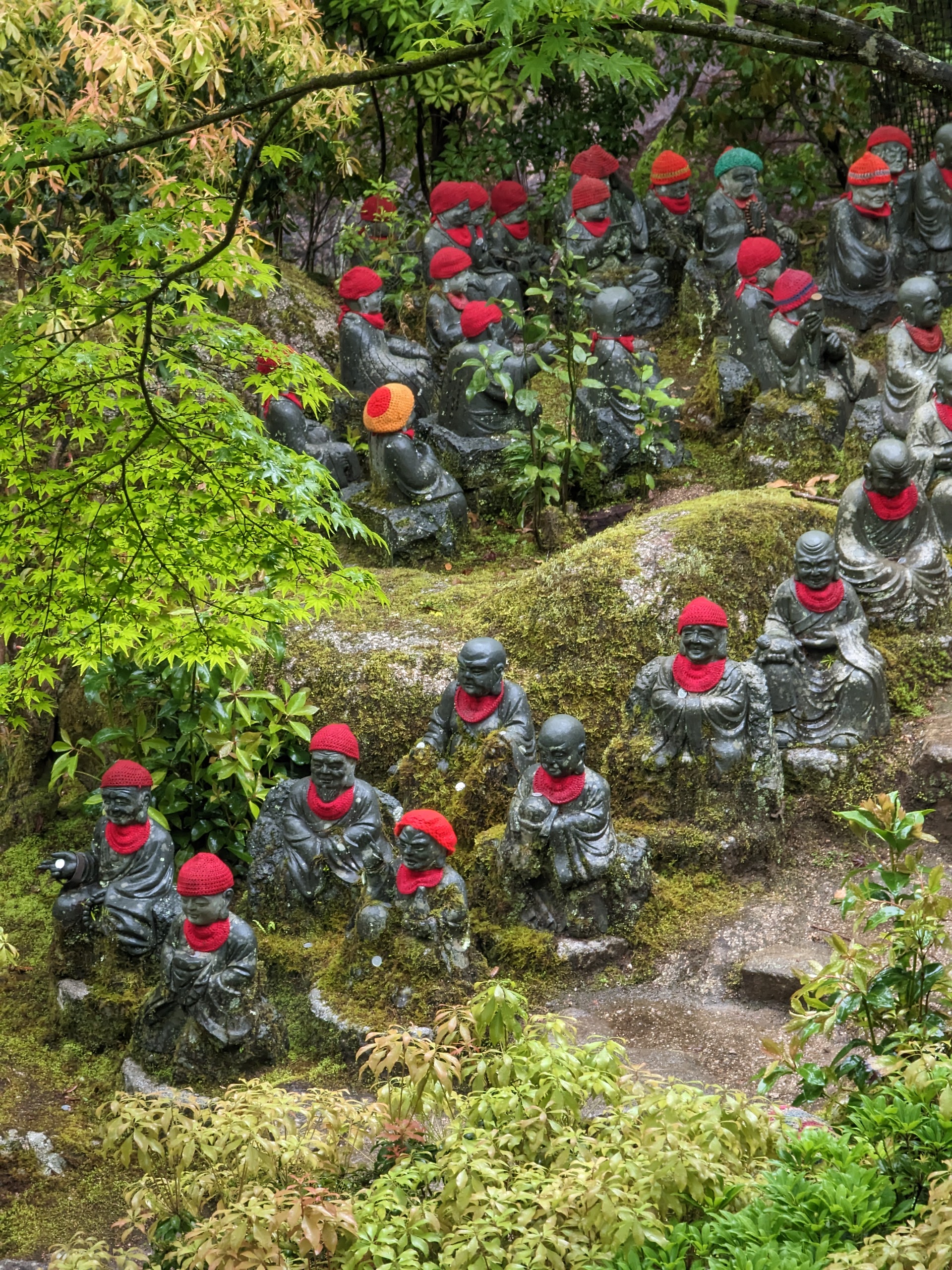
We climbed the long stairway and began to notice something unusual – hundreds and hundreds of tiny statues dotted all around. The temple site was home to around 500 small Buddhas. Some of these miniature statues could even be seen with bright red knitted hats to protect them from the elements.
One of the best things about the complex was the calmness of it. Extreme serenity. There were no noises to be heard except the gentle patter of rain against the trees and the occasional ringing of a large prayer bell.
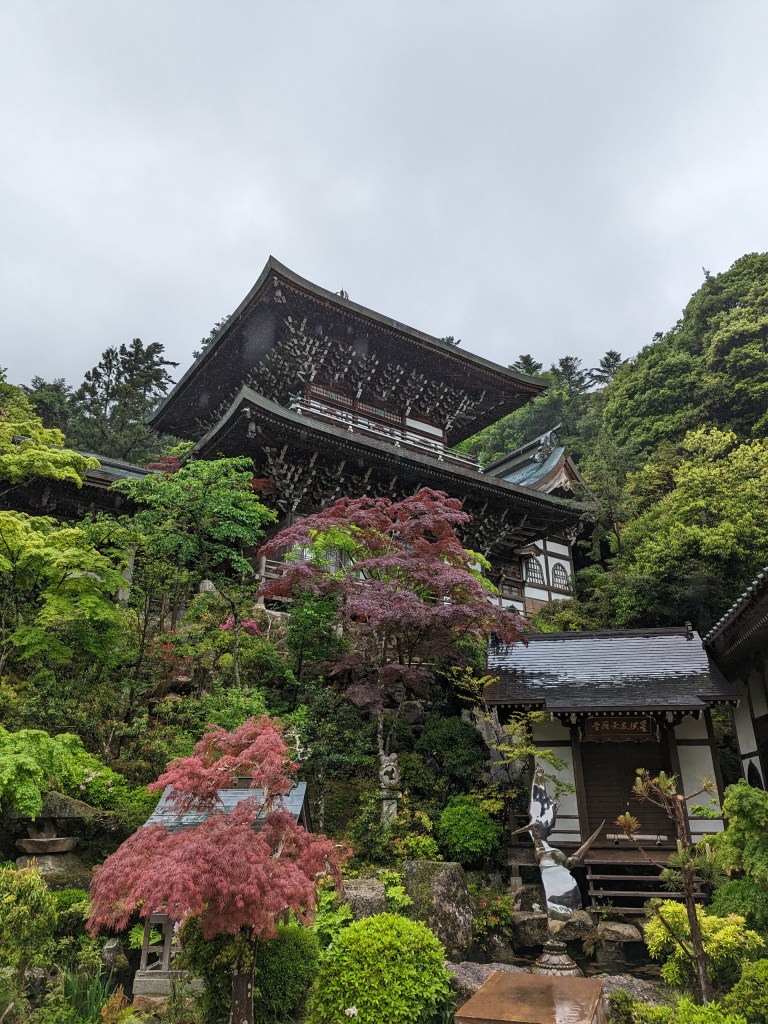
The temple itself was slightly unusual. Just outside the front was a staircase leading down into a dark basement. Yas was smugly smiling not telling us what was under there, so, intrigued, we headed down. Passing a dark curtain we were met with nothing. Nothing? The room was a pitch-black tunnel without a sliver of light. But, as we began to shuffle along we noticed some dimly lit paintings on the walls. Getting closer we could make out that they were of various deities. It was a bizarre experience as we hadn’t a clue how long the tunnel went on for or what to expect as we delved further in. Almost like a Buddhist version of a haunted house – were the walls about to move? Was a man dressed up as a skeleton about to jump out? We waddled past around 10 of the paintings before finding the exit and bundling out. Grinning on the other side, Yas explained that people go down there in hopes of being granted visions by one of the gods depicted. Obviously, we were not worthy.
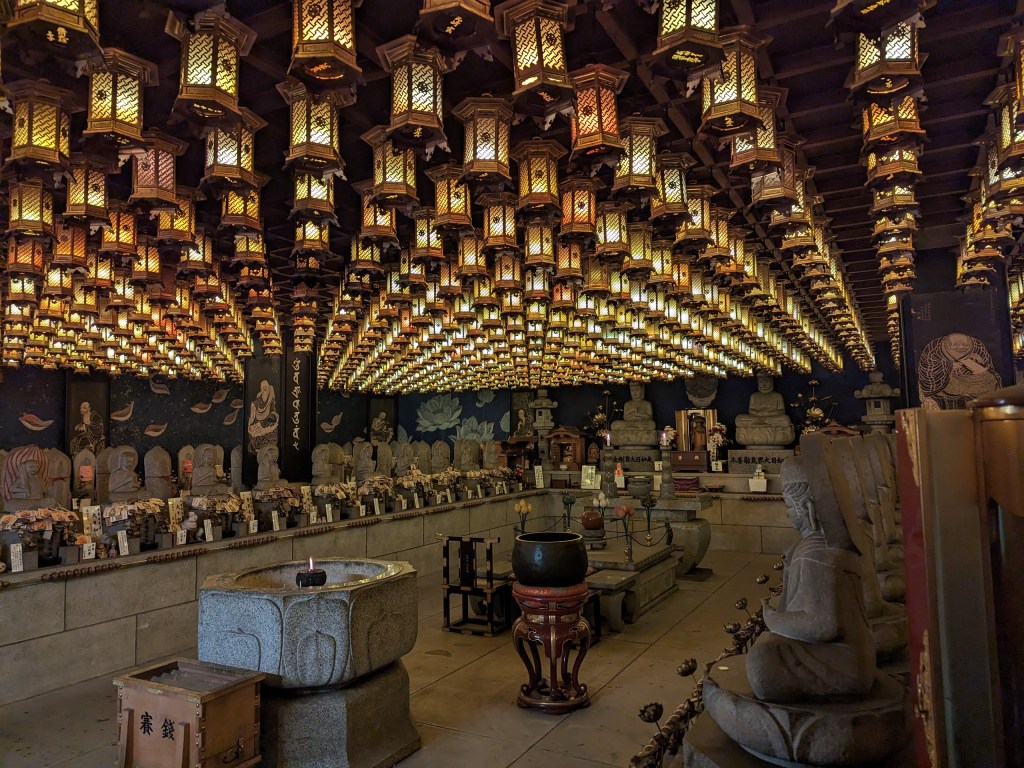
A little further up the mountain, we came to a cave filled with yet more statues, except these were presented slightly differently. The ceiling was covered in lanterns, a small flame flickered in the center awaiting incense, and, most significantly, under each of the busts was a long pole with round beads attached. Every statue in the room represented a temple along the Shikoku Pilgrimage, a trek that stretches the entire island of Shikoku and involves visiting 88 temples. The route is typically completed on foot with pilgrims being distinguishable by their all-white clothing, but in modern times cars, taxis, busses, and bikes can all be used. At around 1200km and taking anywhere from 30 to 60 days to complete, the journey is not for everyone. That is where this cave on Miyajima Island comes in. Instead of visiting each temple, you can walk around the room moving the beads under the statues from left to right. When all the beads have been moved you can say your spirit has visited every site along the pilgrimage. So cut to us spending the next 30 minutes undergoing intensive abacus training, moving the beads around one by one.

After a few more hours of exploring The Lost World, it was time to catch the ferry and head back for an early night. There was to be no late night arcades for tomorrow it was off to our final (!) tour destination, Osaka. It was a city I knew very little about but one that we quickly grew to love and one that potentially surpassed even the might of Tokyo.
 Sam Byford